


 \n
\n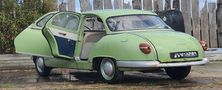
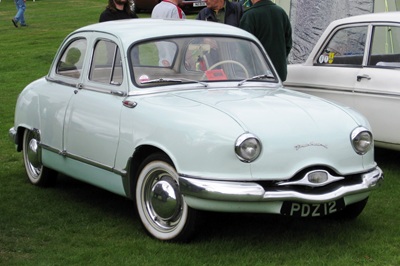
On the Dyna Z, the light body is not brochure decoration. It belongs to the project itself. Panhard wanted a roomy, economical saloon without too much weight, and that decision changed everything: the character of the car, its efficiency and even part of its industrial limits.
Weight matters as much as shape
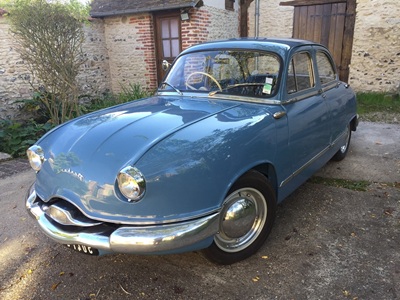
The flowing line of the Dyna Z is easy to remember, but that silhouette only makes sense if mass stays controlled. At Panhard, the lighter body helps make better use of the 851 cc twin, keeps fuel use reasonable and preserves respectable performance for a family car.
The Dyna Z therefore does not try to impress through brute force. It tries to do more with measured mechanics.
Duralinox as a coherent choice
The early light structures answered an engineering method. The lighter the body remained, the more fully the car delivered its promise of efficiency. The point is not a rare or spectacular material by itself. It is the balance of the whole of the model.
That is also why the Dyna Z holds a special place in post-war French motoring. It pushes one idea further than many rivals dared to do.
Why Panhard changed the formula
This brilliant solution carried a cost. A lighter body is more complicated to produce and harder to sustain economically if volumes remain small. The marque therefore had to evolve the formula toward solutions more manageable in serial production.
For today's collector, that shift matters. It explains why not every Dyna Z should be reviewed in the same way across the production years.
What it changes in restoration
On a real car, the question is not only historical. It touches panel condition, the quality of past repairs and the fidelity of the car to its period. Restoring a Dyna Z therefore begins with identifying exactly what is in front of you before deciding how to intervene.
An alloy that demands its own craft
Duralinox cannot be treated like ordinary steel sheet. Before intervening, a restorer has to identify the material, understand earlier work and choose a compatible process. Poor welding, reshaping or fastening can introduce stress, distort a panel or encourage corrosion where dissimilar metals meet. Aggressive stripping may also thin a skin that has already lost some of its strength.
Joints matter as much as broad panels. Rivets, screws, seams, reinforcements and sealants often preserve evidence of successive repairs. A bright newly painted component is not necessarily sound, while stable marks of age do not automatically require replacement. A good decision comes from studying each local construction and material, not from applying one restoration method to the entire shell.
Weight alone does not explain the car
Lightness works because it is paired with an aerodynamic form and an engine designed around efficiency. Removing mass helps acceleration, flexibility, braking and fuel consumption, but the Dyna Z would not have achieved the same result without its useful cabin and low drag. Panhard was not simply building an aluminium curiosity. It created a system in which each engineering choice reduced the burden on the others.
That ambition gives surviving early cars considerable documentary value. An undisturbed body records panel thicknesses, joints and factory practices that repeated restoration can erase. Retaining original work where possible, photographing it before dismantling and insulating dissimilar metals are consequently historical acts as well as technical ones. The alloy is more than a sales feature; it remains central to the industrial identity of the first Dyna Z models.
Before buying an early car, an inspection by someone experienced with light alloys avoids two opposite mistakes: overvaluing a body hidden beneath recent paint or condemning an area that can be repaired. The estimate should separate dismantling, reshaping, possible replacement and protection of the joints. That document makes the price comparable with a steel-bodied example and confirms that material rarity never cancels the cost of the skill required to preserve it.
